Medically reviewed and authored by Larry M. Wolford, DMD — Board-Certified Oral & Maxillofacial Surgeon, Dallas, TX. Last reviewed: May 2026.
Educational disclaimer: This article is for general educational purposes and is not a substitute for an individualized medical evaluation. Surgery for obstructive sleep apnea is appropriate only for certain patients and is determined through sleep testing, examination, and imaging. No outcome is guaranteed; results vary by patient.
The CPAP machine sits on the nightstand, unused. Maybe the mask never sealed. Maybe the noise kept a partner awake, or travel made it impractical, or it simply felt like sleeping inside a wind tunnel. So it gets set aside — and the exhaustion, the morning headaches, the afternoon fog, and the strain on the heart quietly continue. Untreated obstructive sleep apnea doesn’t pause because a device is inconvenient.
For a specific group of patients, the reason CPAP feels like a lifelong battle is anatomical: the airway is structurally narrow because of where the jaws sit. When that’s the case, moving the skeletal framework forward can treat the obstruction at its source rather than forcing air past it every night.
The Real Problem: A Structurally Narrow Airway
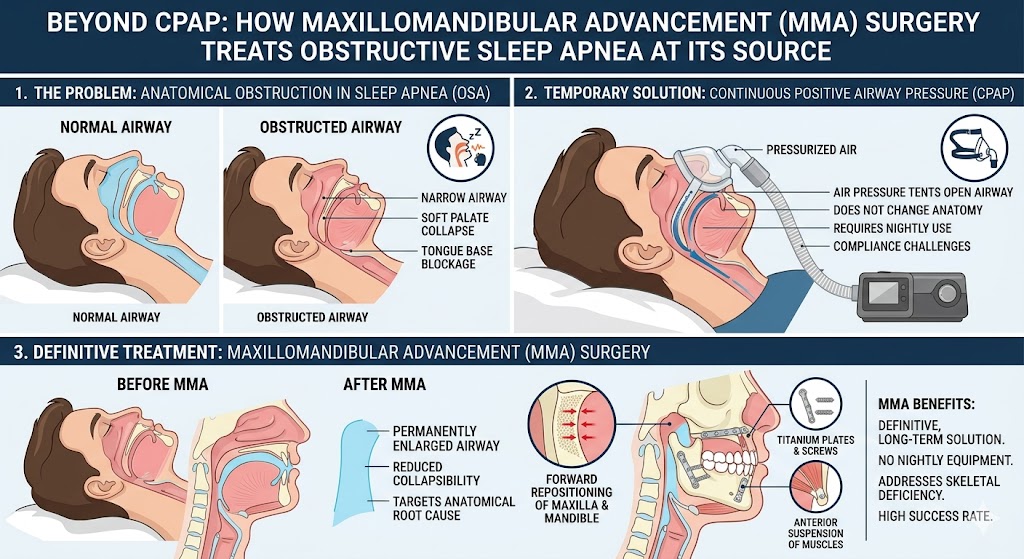
The obstacle in obstructive sleep apnea (OSA) isn’t effort or willpower — it’s airway collapse. As the National Heart, Lung, and Blood Institute explains, OSA occurs when the upper airway becomes blocked during sleep, often as the tongue and soft tissues fall backward and close off the passage behind the throat.
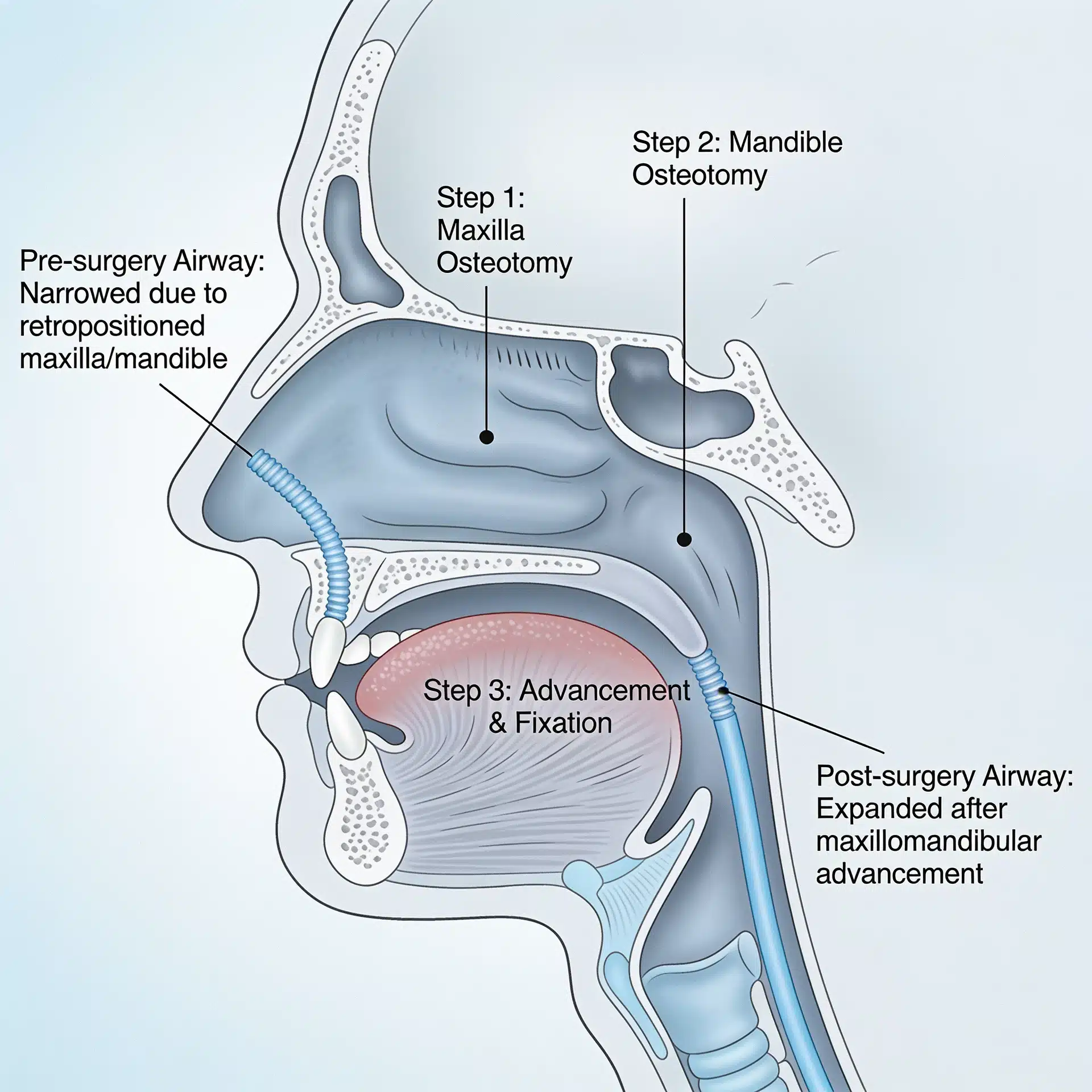
For many people, that collapse is driven by jaw position. When the upper and lower jaws sit too far back — frequently alongside a high occlusal-plane (steep bite) angle — the tongue and soft palate have less room, and the posterior airway space narrows. CPAP manages this by splinting the airway open with pressurized air every night. It treats the airflow, not the anatomy. That distinction is the whole reason structural surgery exists: if the bones are the bottleneck, the most durable fix addresses the bones.

What an Experienced Maxillofacial Surgeon Brings to the Decision
The goal here isn’t a guaranteed cure — no ethical surgeon promises that. The value is precise airway-focused planning by a surgeon who treats the jaws and the airway together. Maxillomandibular advancement is one of the most effective surgical treatments for OSA in well-selected candidates, but outcomes depend heavily on how the advancement is planned and executed.
Dr. Wolford is particularly known for refining the counter-clockwise rotation of the maxillomandibular complex. Rather than simply sliding both jaws straight forward, this approach also changes the bite angle — allowing greater effective advancement of the lower jaw and chin, maximizing the opening of the posterior airway space while keeping the facial profile balanced. His own published research has documented substantial, stable increases in posterior airway space with this technique, and he has authored over 185 peer-reviewed publications across his career. (For the technique in more depth, see maxillofacial surgery for sleep apnea and his published airway research.)
Key Takeaways
- Maxillomandibular advancement (MMA) moves the upper and lower jaws forward, pulling the tongue and soft palate with them and enlarging the airway.
- It treats the anatomical cause of OSA rather than managing airflow nightly, as CPAP does.
- It’s for the right candidate — typically patients with skeletal anatomy contributing to their OSA, or those who can’t tolerate or aren’t helped by CPAP.
- Counter-clockwise rotation can maximize airway opening while preserving facial balance.
- Sleep testing is required. Diagnosis and severity are established by a sleep study, not by symptoms alone.
- Goals are realistic: large, durable reduction in apnea events and improved sleep and daytime function. Results vary; surgery is not a guaranteed cure for everyone.
How the Decision Is Actually Made
Short answer: MMA is considered when a sleep study confirms obstructive sleep apnea, the airway anatomy points to a skeletal contribution, and either non-surgical therapy hasn’t worked or isn’t tolerated — and it works best when the advancement is planned in three dimensions and the jaw joints are confirmed stable enough to support it.
Here is the reasoning behind that answer.
Diagnosis is confirmed by a sleep study. OSA is diagnosed and graded by polysomnography (a sleep study), which measures how often breathing is interrupted. The NHLBI outlines how sleep apnea is diagnosed and the range of treatments available — surgery is one option within a larger landscape that includes CPAP, oral appliances, and lifestyle measures.
Non-surgical therapy comes first for most patients. CPAP is effective when used consistently, and for many people it’s the right answer. Surgery enters the conversation when CPAP fails, isn’t tolerated, or when the underlying anatomy makes a structural correction the more durable solution. (Sleep apnea surgery vs. CPAP compares the trade-offs.)
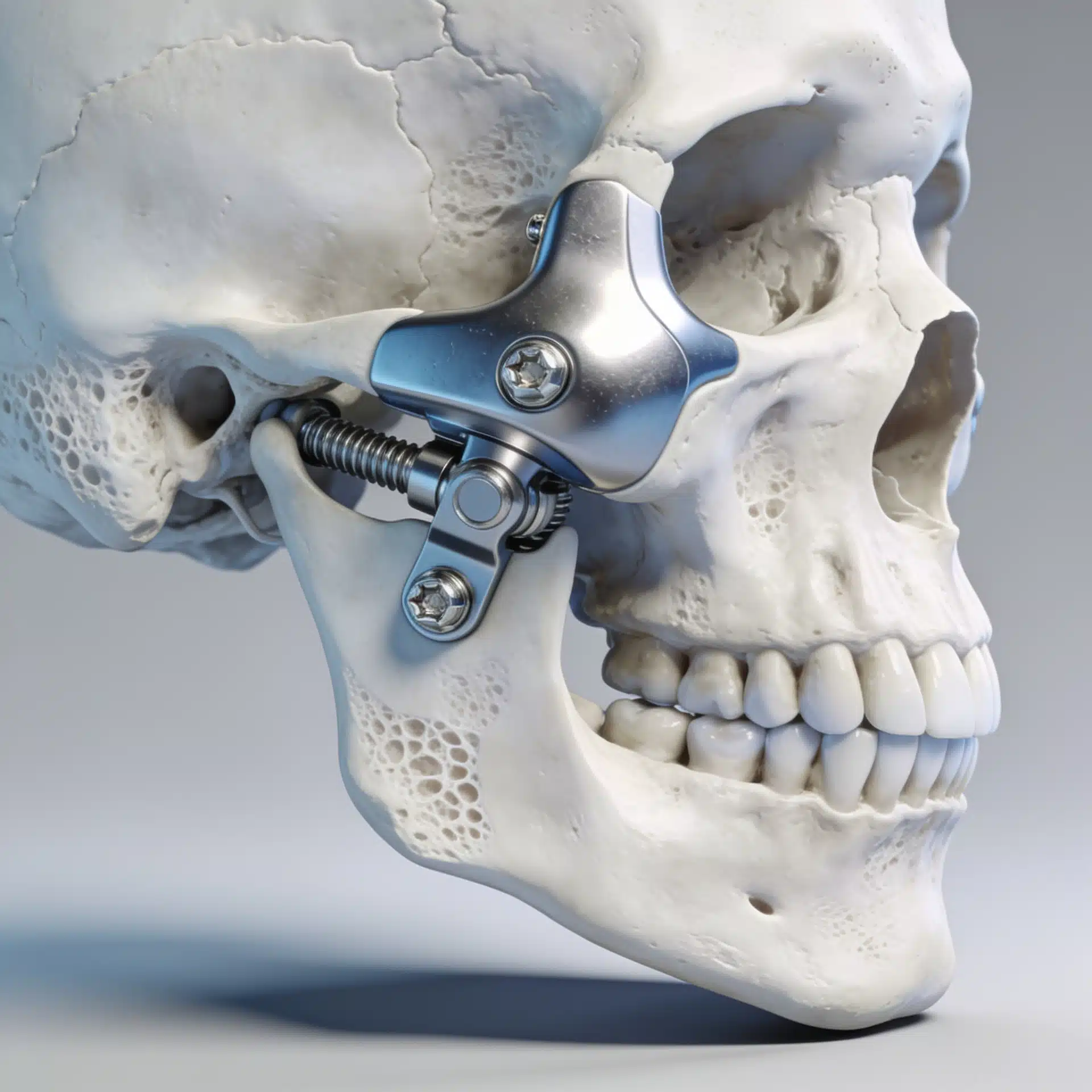
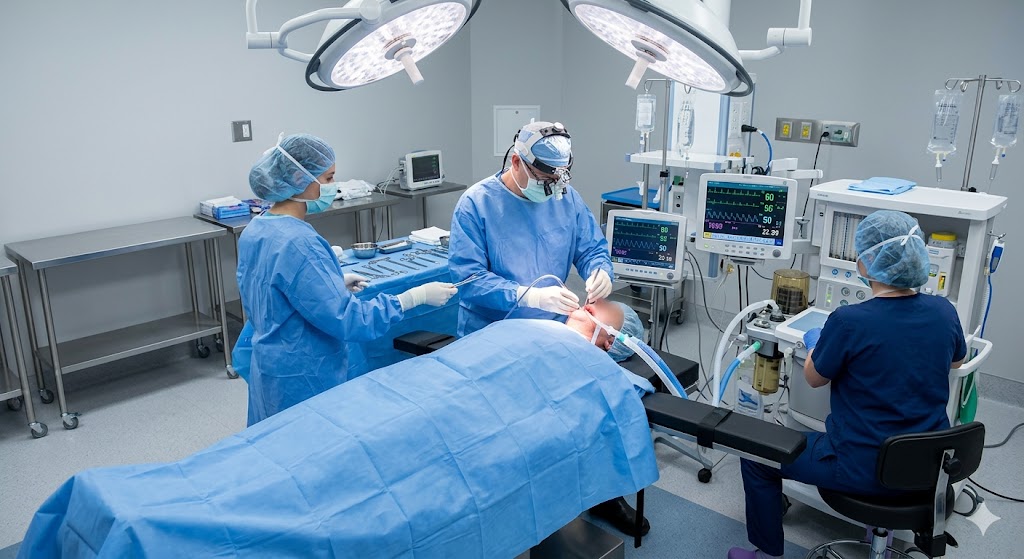
The advancement is planned in three dimensions. Modern MMA uses 3D imaging to map the airway and simulate the movement before the operation. The jaws are advanced forward — often combined with counter-clockwise rotation — and secured in their new position with titanium plates and screws. Because the tongue and palate are attached to the jaws, moving the skeleton forward enlarges the airway in a way devices cannot.
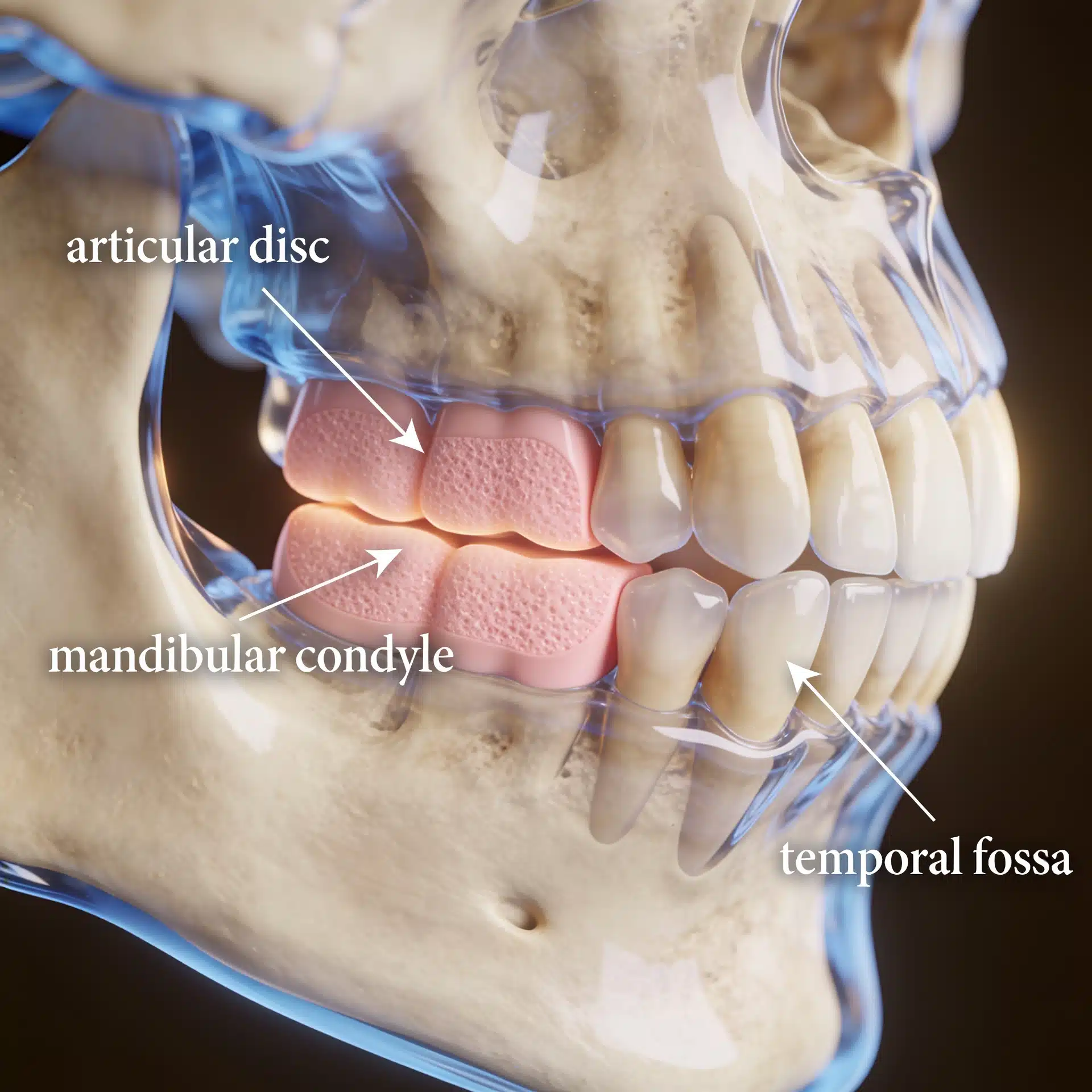
The jaw joints are assessed before advancing the jaws. Stability of the temporomandibular joints matters: advancing the jaws onto unstable or diseased joints risks relapse. When indicated, nasal obstruction (such as enlarged turbinates) may also be addressed at the same operation to ensure clear breathing through the nose.
Success is defined honestly. Realistic objectives are a major, lasting reduction in apnea events, better oxygenation during sleep, and improved daytime function — and in well-selected patients, resolution of OSA. Like any major surgery, MMA carries risks and a defined recovery, since the facial bones must heal into their new position. A candid discussion of risks and expected outcomes is part of informed consent.
Where This Care Happens
Dr. Wolford’s practice is located on the campus of Baylor University Medical Center, Worth Street Tower, 3409 Worth Street, Suite 400, Dallas, TX 75246 — minutes from downtown Dallas and accessible from across the Dallas–Fort Worth metroplex. Valet parking is available, with self-parking in the adjacent building.
Patients travel to Dallas from across the country and internationally, often flying into DFW or Dallas Love Field, for airway and jaw surgery. All procedures for both current and new patients are performed exclusively at the Dallas office. Out-of-town patients can review what to bring — including any sleep study results — on the patient information page. A free initial telephone consultation is available at 214-828-9115, or you can contact the office online.
Frequently Asked Questions
Can jaw surgery actually treat sleep apnea, or just snoring? For appropriately selected patients, maxillomandibular advancement treats the airway obstruction that causes OSA, not just snoring. It is considered one of the most effective surgical options for severe OSA when the anatomy is suitable.
Do I have to fail CPAP before considering surgery? Not necessarily, but CPAP is the standard first-line therapy and works well for many. Surgery is most often considered when CPAP isn’t tolerated or effective, or when skeletal anatomy makes a structural correction the more durable choice.
Will surgery change how my face looks? Advancing the jaws does change the profile. With careful planning — including counter-clockwise rotation when appropriate — the goal is a balanced, natural result alongside the airway improvement. Your surgeon will review expected changes with you beforehand.
How is candidacy determined? Through a confirmed sleep study, a clinical exam, 3D imaging of the airway and jaws, and an assessment of the jaw joints. There is no generic candidate — it’s an individual evaluation.
Is MMA a permanent solution? The skeletal change is permanent, and results are typically durable in well-selected patients. As with any treatment, long-term follow-up is recommended, and outcomes are not guaranteed for everyone.
Will insurance cover it? Surgery for OSA is frequently covered when medically necessary and documented by sleep testing. When surgery is recommended, the office prepares a pre-authorization letter for your insurance company. Coverage depends on your individual plan.
About the Author
Larry M. Wolford, DMD is a board-certified oral and maxillofacial surgeon in Dallas, Texas (NPI 1821178955; National Provider Taxonomy: Oral & Maxillofacial Surgery, 1223S0112X). He earned his DMD from Temple University School of Dentistry and completed his residency in Oral and Maxillofacial Surgery at the University of Texas Southwestern Medical School in Dallas.
He is a Diplomate of the American Board of Oral and Maxillofacial Surgery and has served on its Advisory Committee, and a Clinical Professor of Oral and Maxillofacial Surgery and Orthodontics at Texas A&M University Health Science Center, Baylor College of Dentistry. His professional memberships include the American Association of Oral and Maxillofacial Surgeons, the American Society of TMJ Surgeons, the American Academy of Craniomaxillofacial Surgeons, and the American Academy of Craniofacial Pain.
Over a career spanning more than four decades, Dr. Wolford has authored over 185 peer-reviewed publications and more than 150 scientific abstracts, holds multiple patents for surgical techniques and devices, and is recognized for his research on maxillomandibular advancement with counter-clockwise rotation and its effect on the posterior airway space. He has trained hundreds of surgeons through fellowship programs and lectures worldwide on orthognathic, TMJ, and airway surgery.
Practice: Baylor University Medical Center, Worth Street Tower, 3409 Worth Street, Suite 400, Dallas, TX 75246 · Free initial telephone consultation: 214-828-9115
Verify credentials via the NPPES NPI Registry.
Related Reading on This Site
- Sleep Apnea Surgery vs. CPAP: When Jaw Surgery Is the Better Long-Term Answer
- Maxillofacial Surgery for Sleep Apnea: A Permanent Airway Solution
- Can Jaw Surgery Cure Your Sleep Apnea?
- Living With Sleep Apnea: How Jaw Surgery Can Help
- Research: Double Jaw Surgery Effects on Obstructive Sleep Apnea
- Orthognathic Surgery: Correcting Jaw Misalignment
- About Dr. Larry M. Wolford, DMD
- Patient Information
- Contact the Office
Authoritative Resources (External)
These independent, non-commercial sources offer further patient education:
- National Heart, Lung, and Blood Institute (NIH): Sleep Apnea — causes, diagnosis, and treatment
- American Association of Oral and Maxillofacial Surgeons (professional society): Corrective jaw (orthognathic) surgery overview
A note on patient stories: Any patient example used in marketing for this practice should be either fully de-identified or used only with written patient authorization, consistent with HIPAA. The scenarios described in this article are general and composite, not specific patients.